

A Yosemite Horror Story
- Yosemite Me

- Jul 6
- 4 min read
Updated: Aug 7
“From even the greatest of horrors irony is seldom absent."
— H. P. Lovecraft, The Shunned House (1924)
So begins one of Lovecraft's darker tales — a story about freeing a Providence, Rhode Island house from what he called "one of earth's nethermost terrors," an intrusive presence that had cursed the place for over a century and a half.
The parallel to Yosemite isn't as far-fetched as it sounds. Many people treat the Park as a kind of second home — a refuge where comfort and quiet can be reliably found. But occasionally, something intrudes. Something that, in Lovecraft's phrase, makes "the essentials of time as well as of space seem dissolved and mixed in the most illogical fashion."
I encountered one such intrusion on a walk from Yosemite Village toward Upper Pines Campground.
A high-pitched chirp stopped me at a fork near the old Upper River Campground. My first thought was some rare bird I hadn't seen before. A few more repetitions settled the question: it was the backup alarm of heavy equipment. I veered right at the fork and stepped onto the Housekeeping Bridge.
On the south bank of the Merced, a yellow, 30-ton CAT excavator had taken up residence. Its tracks ground back and forth along the riverbank, churning soil and whatever vegetation remained. No rare bird. A machine.
The irony arrived almost immediately. This is, after all, the same Park where I once stepped a few feet off a trail in Tuolumne Meadows to photograph Cathedral Peaks — and was promptly scolded by a passing hiker. "Get out of the Meadow!" she called, in a tone that suggested I had committed something close to a federal offense. She elaborated as she passed: I was trampling the meadow.
I turned to watch her go. Each of her boots struck the hard-packed trail with purpose. It did not appear to occur to her that the trail she walked had also, once, been meadow.
Irony has a way of going unnoticed by the person generating it.
Back at the riverbank, I watched the CAT more carefully. It reached into a pile of ponderosa pines — large ones, root balls still attached — and began driving them horizontally into the excavated bank. I had never seen anything like it. I walked toward Housekeeping Camp to find out what was happening.
Near the caution tape, a sign explained the work. It described the removal of riprap that was "no longer functional," to be replaced with bioengineered structures using live plants to stabilize the bank and restore riparian habitat. The sign closed with a polite request that visitors “avoid trampling vegetation” along the riverbank by staying on maintained trails.
I stood there with that for a moment.
The horror story had become a restoration story. The monster was, apparently, doing good work.
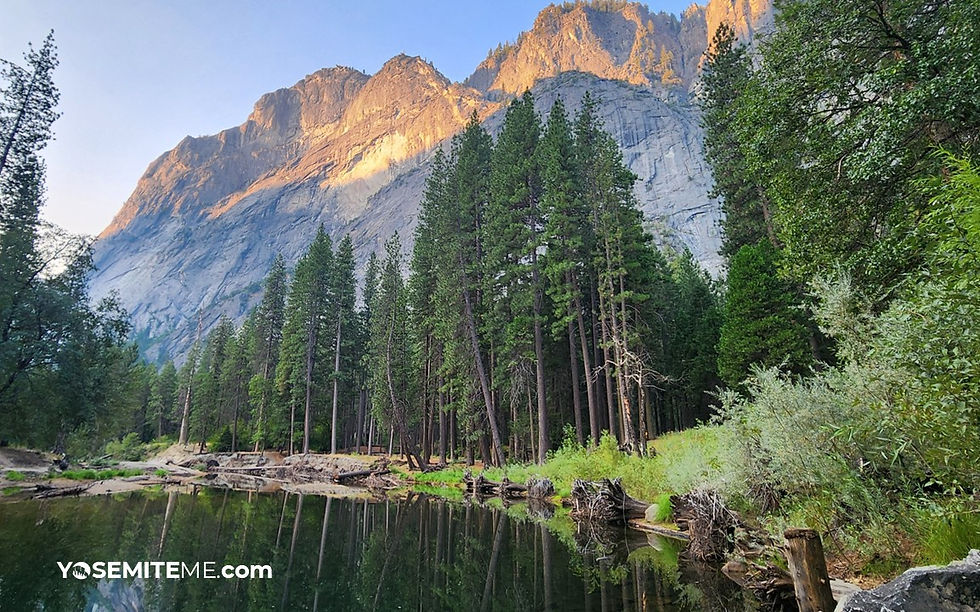
And — to be fair — it seems to have worked. Nearly ten years later, the root-ball bioengineering has held. The bank below Housekeeping Units shows no significant erosion. Willows have grown in. The river flows past looking, more or less, like a river is supposed to look.

This is what we might call an acceptable means. The disruption was real; the outcome justified it. The Park Service made a reasonable calculation, tolerated a season of ugliness, and produced something lasting. You can walk past it now and not know anything happened.
We're fairly good at that — accepting the means once the ends look clean enough.
But not every story ends that way.
The Tuolumne River, like the Merced, is a federally protected waterway under the Wild and Scenic Rivers Act — a law designed to preserve free-flowing rivers in their natural state. Except at one particular point. At the narrow western throat of Hetch Hetchy Valley — what John Muir called the "exact counterpart" to Yosemite Valley — the Tuolumne runs into the O'Shaughnessy Dam, completed in 1923.
The reservoir behind it has been there for over a century. Three former Yosemite superintendents described it in a 2017 letter as "the greatest blemish in all our national parks," and called for a commitment to undoing "one of the worst examples of that destruction."
The dam supplies water to San Francisco. That is the end that was chosen. The beauty and accessibility of the Hetch Hetchy Valley for millions of people is the means that was spent to get there.
Here is where the horror story gets complicated. The Merced restoration worked because the disruption was temporary and the goal was the river's health. Hetch Hetchy is different: the disruption is the permanent condition, and the goal had nothing to do with the river. One was a means to restoration. The other was a means to consumption.
We accepted it anyway. More than accepted — we forgot, mostly. The dam has become scenery. Visitors photograph the reservoir. The valley beneath it is remembered mainly by people who go looking.
Lovecraft's haunted house, you'll recall, had a monster in the cellar. The protagonist eventually confronts it, destroys it, and the house is freed. A satisfying resolution.
Hetch Hetchy has no such ending scheduled. The means became permanent. The end — a wild valley running free — remains unfinished.
The irony Lovecraft promised at the start of his tale is seldom absent, even here. We built the infrastructure to protect Yosemite from intrusions like a CAT on the Merced, then flooded the twin of Yosemite to power the city that sends most of its visitors.
Sometimes that kind of irony is worth sitting with — not to produce outrage, but to stay honest about what we've traded, and what we keep choosing not to reclaim.
The Merced flows on. The Tuolumne does too, where it can.


Comments